Pricing guide
AI consulting rates in 2026
AI consulting rates are the number everyone shopping for a firm wants and almost nobody prints. Here’s what published 2026 rate guides agree on, what moves the price, and, since we’re an AI consultancy ourselves, the range we actually charge.
The rates, in one table
| Engagement | Published 2026 range | Where the number comes from |
|---|---|---|
| Hourly consulting | $150–$500 per hour | published 2026 AI consulting rate guides; $300+ is senior/specialist territory |
| AI readiness assessment | $15,000–$50,000 | published boutique ranges for AI readiness assessments (2026) |
| AI governance assessment | $25,000–$75,000 | published boutique ranges for a 4–8 week governance maturity assessment |
| Scoped implementation build | $50,000–$250,000 | published 2026 ranges for a typical scoped production build; small builds start near $20k |
| Ongoing advisory retainer | $5,000–$15,000 per month | published ranges for ongoing AI advisory retainers |
| Tillerbridge fixed-scope assessment | $20,000 to $80,000 | our own published range; 3–6 weeks |
Two things that table undersells. On implementation, that band is a single scoped build; multi-system, multi-year programs run seven figures and beyond, and scale like that is work we take. On retainers, retainers at that band cover a steady advisory seat; embedded fractional leadership across a large organization prices well above it.
And a sourcing note: the market figures are what 2026 rate guides publish, not a survey with a methodology behind it. Ranges this wide are the honest shape of the market, not quotes. Treat anything narrower with suspicion.
What the tiers mean
The hourly band is wide because it covers three different animals. Independent consultants sit toward the bottom: senior people, no overhead, and you get exactly one of them. Boutique firms sit in the middle, selling small senior teams end to end. The Big Four and the strategy houses sit at the top and past it, and the premium buys brand cover, insurance, and how many people show up to the kickoff, more than it buys different advice.
The practical read: a contained technical question fits an independent; a project that has to survive contact with your operation fits a boutique; board politics at enterprise scale is what the big firms are for.
What moves the price
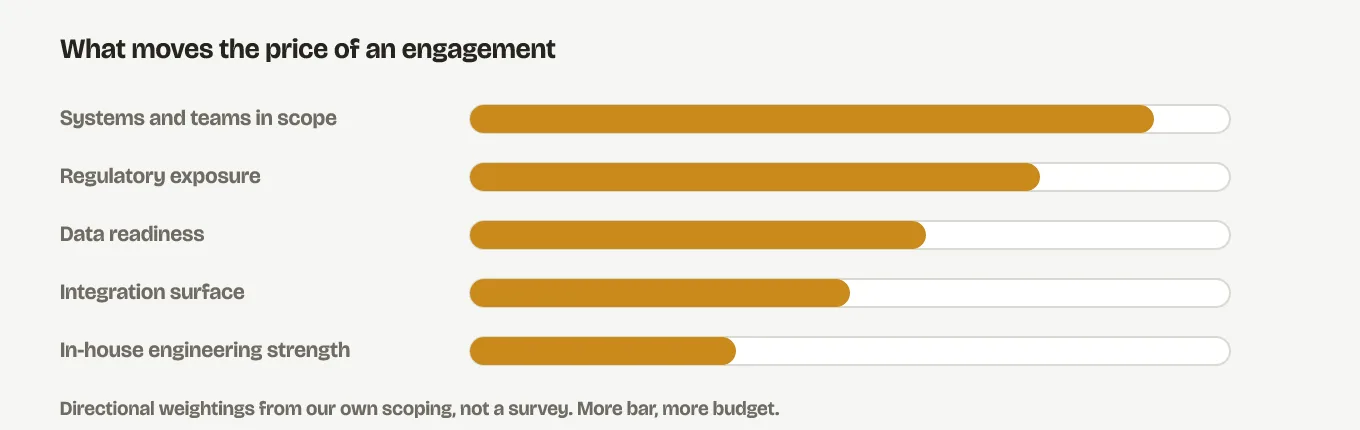
Up:
- Regulated or sensitive data. Health, finance, and government work means more controls, more reviews, more sign-offs, all billable.
- System count. Wiring AI into one tool is cheap. Threading it through five legacy systems is engineering.
- Production versus pilot. A demo takes a week. Something your operators depend on every day takes testing, monitoring, and documentation.
- Stakeholder count. Every additional approver adds meetings, and meetings bill.
- Urgency. Compressed timelines price like overtime, because they are.
Down:
- One clearly scoped problem and one decision-maker.
- Data that’s already usable where it sits.
- Willingness to phase the work, with checkpoints where you can stop and keep what’s been built.
Hourly, fixed scope, or retainer
Hourly is the market default and, for buyers, the weakest of the three. The meter runs, the incentive points at more hours, and two hourly bids can’t be compared because neither commits to an outcome. It’s a fair model for small, genuinely open-ended advice, and a poor one for anything you’d call a project.
Fixed scope moves the estimating risk onto the firm, which is where the expertise lives. You get a number, a deliverable, and bids you can actually compare. Our take, as a firm that sells fixed scope: push for it. A firm that can’t carve a fixed-scope first engagement out of your problem is telling you how well it understands the work.
Retainers make sense when what you’re buying is ongoing leadership rather than a project: the retainer band in the table, or a fractional chief AI officer arrangement when the role needs a name and a seat.
When programs run seven figures
Everything above prices single engagements. Multi-year programs across many systems and teams run seven figures and beyond, and that’s ordinary arithmetic rather than gouging: a handful of senior people over a couple of years costs what senior people cost. What changes at that scale is how you should buy. Phase the program, put break points in the contract, and never sign the whole thing on the strength of a deck. Any firm confident in its own roadmap will accept checkpoints; the ones that resist are pricing your exit, not your project.
How to buy AI consulting well
- Ask for a fixed-scope first engagement. Any serious firm can carve one out of your problem.
- Ask who does the work, by name. Then check those names show up.
- Ask for a price range before the second call. A firm that won’t name a number is deciding what you’ll pay based on your logo, not the scope.
- Ask what happens if the honest answer is “don’t build this.” The best money you’ll ever spend on AI might be the assessment that stops a bad project.
- Settle ownership up front: who owns what gets built, and can your team run it without the firm.
Before any of that, it’s worth knowing whether you’re ready to buy at all. Our AI readiness checklist covers what to have in order first, and the services page shows how the engagement types fit together.
Our published range
Our fixed-scope initial assessment is $20,000 to $80,000, delivered in 3–6 weeks; where in that range depends on scope: how many systems and teams we assess, company size, and regulatory exposure. Larger implementation and advisory work is scoped and priced after the assessment, so the number you get is grounded in your systems rather than our optimism.
We publish this because most firms won’t, and we think that’s a tell. Printing the range costs us nothing but awkwardness, saves both sides the three-call dance toward a number, and lets you rule us out from this page if the budget doesn’t fit. That’s a feature.
Questions people ask
- How much does an AI consultant cost?
- For a project, published 2026 rate guides put assessments at roughly $15,000–$50,000 and a scoped production build at $50,000–$250,000; that band is a single scoped build; multi-system, multi-year programs run seven figures and beyond, and scale like that is work we take. Hourly, the same guides run $150–$500 per hour. Our own fixed-scope assessment is $20,000 to $80,000, published on our services page.
- How much do AI consultants charge per hour?
- $150–$500 per hour, across published 2026 guides. Independents sit toward the bottom of that band, boutique firms in the middle, and the Big Four and strategy houses at the top and past it. The band is wide because it prices three different kinds of firm, not three levels of correctness.
- Why don’t most consulting firms publish their rates?
- Because unpublished prices let a firm charge each buyer what that buyer looks able to pay, and because partners worry a printed number anchors negotiations low. Both reasons serve the seller. There’s no buyer-side benefit we’ve ever heard argued with a straight face.
- How much should I charge for AI consulting?
- If you’re the consultant: price against the tiers in the table above, not against your salary math. Fixed scopes win bids against hourly quotes at the same expected cost, because buyers can compare them. And name a range early; the firms that won’t are the ones buyers learn to distrust.
- Do higher rates buy better results?
- Nobody has measured it, and we won’t pretend otherwise. What the top of the band reliably buys is capacity, brand cover, and process; whether it buys better advice depends on who actually shows up. Match the firm to the job: contained technical question, independent; end-to-end senior work, boutique; board politics at scale, big firm.
Tell us about the work.
A few lines is enough. We read every enquiry ourselves and reply within one business day.